

Track contribution, not ownership. That should be a starting principle as World Health Organization Member States continue negotiating the Pathogen Access and Benefit Sharing (PABS) Annex to the Pandemic Agreement. Provenance matters: countries, patients, laboratories, and data generators should be recognized for what they contribute. But a vaccine, diagnostic, or medicine is rarely traceable to one specimen or sequence as the singular source of its scientific value. PABS should reflect how research actually works: through cumulative evidence assembled across patients, laboratories, jurisdictions, and time.
The current outbreaks make that distributed reality visible. As of July 26, WHO reported that the Bundibugyo virus disease outbreak in the DRC continued to intensify, with sustained transmission, increasing mortality, and geographic expansion. The cumulative number of cases had surpassed both previously recorded Bundibugyo outbreaks, making it the largest outbreak caused by the virus to date. Earlier cases and specimens crossed borders into Uganda, and Pathoplexus now lists 205 Bundibugyo sequences overall, including 2026 outbreak records from the DRC, Uganda, and Germany. The evidence base continues to grow even as access conditions and release timelines vary.
The M/V Hondius outbreak began as a transnational event. WHO’s final update reported 13 cases, including three deaths: 12 were laboratory confirmed and one was probable. All confirmed cases were among people who travelled on the ship, while care, laboratory testing, contact tracing, and sequence generation were distributed across multiple jurisdictions. By July 2, all identified contacts had completed follow-up without additional secondary cases, and WHO concluded that transmission had been interrupted and the outbreak no longer posed a public-health risk. Pathoplexus now lists 15 Andes virus sequences collected during the 2026 event period across eight jurisdictions. The event is over, but its policy lesson remains current: pathogen evidence rarely stays within one national chain of custody.
In both outbreaks, the genomic record changed as laboratories added sequences, revised records, released data on different timelines, and were deposited within Pathoplexus under both open and restricted-use terms and conditions. That matters for PABS design. A system built around the first available sequence would freeze a scientific process that is inherently cumulative. Later specimens may confirm that an early sequence was representative, reveal additional diversity, improve a diagnostic target, or supply the material needed to validate a product. The contribution deserving recognition is therefore the evolving evidence chain, not only the first link in it.
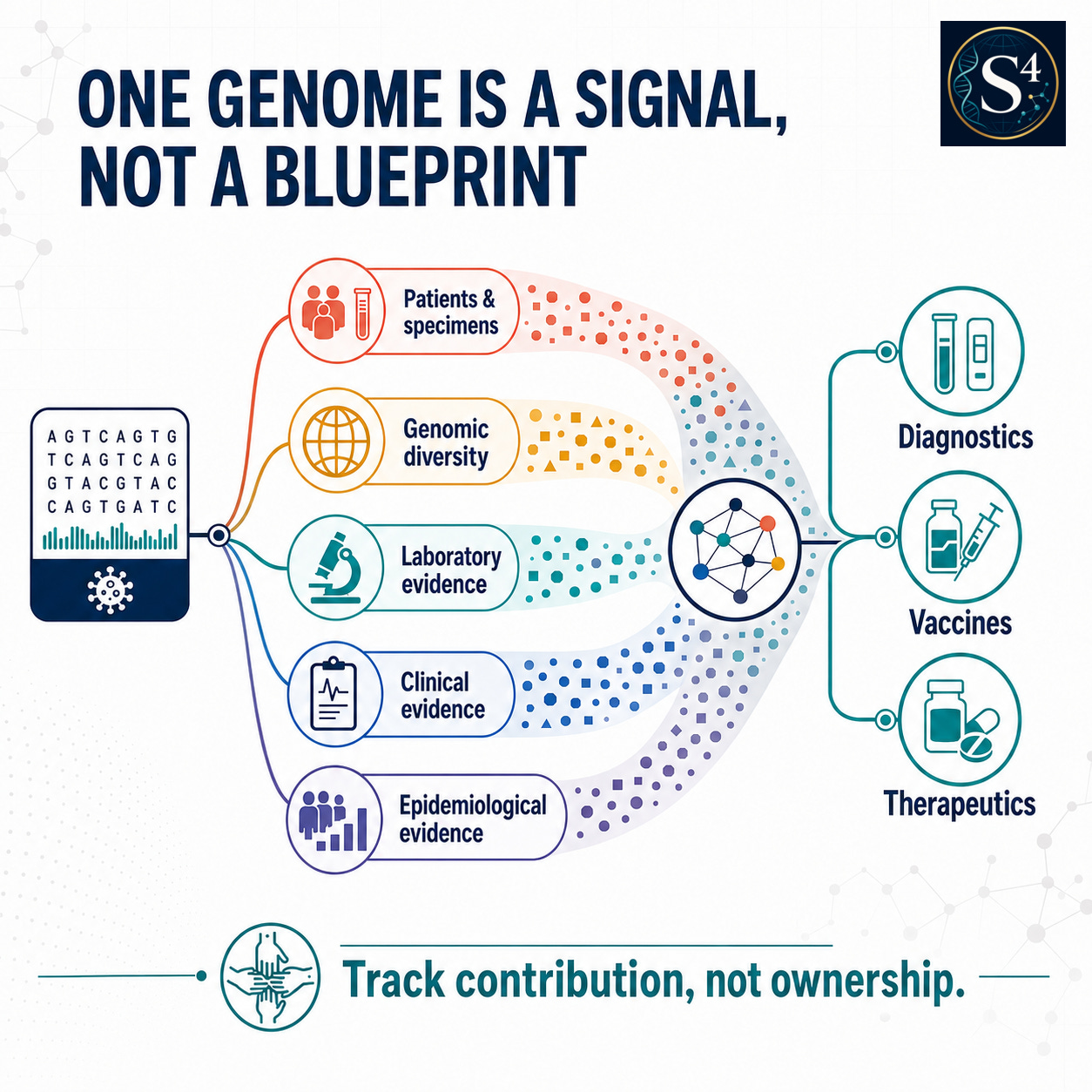
One genome is a signal, not a blueprint
Outbreak products are not designed or tested around the viral genome in one patient. A sequence from an early case can launch scientific work, but it is a snapshot of a moving target. As transmission continues, pathogens circulate through different populations and may acquire genetic differences that affect detection, antigen selection, susceptibility to therapeutics, or interpretation of laboratory results.
That is especially important for Bundibugyo virus. There is no licensed vaccine or specific approved therapeutic for this species. WHO has had to assess candidate vaccines and treatments and establish research and regulatory pathways during an escalating emergency. Existing Ebola products developed for other species must be evaluated for possible cross-reactivity or cross-protection. Rapid access to specimens and sequences from many patients and settings therefore has practical value: it helps researchers determine what is conserved, what has changed, and which existing or experimental tools may still work.
The value of sharing is therefore not exhausted by the first specimen or first uploaded sequence. It accumulates through contributions from patients, clinicians, field investigators, national laboratories, sequencing teams, database operators, product developers, trial networks, and regulators. Recognizing that distributed contribution does not weaken the case for equitable access. It strengthens the case for benefit-sharing rules that are transparent, predictable, and scientifically credible.
Diagnostics need diversity
The point is clearest in diagnostics. Polymerase chain reaction assays are designed by comparing many genomes and identifying target regions that are sufficiently conserved across the strains a test is expected to detect. If an assay is built around a target that is unusual or changes as the pathogen evolves, performance can degrade in later patients or new geographic settings. For that reason, diagnostic development typically combines sequence-based inclusivity analysis with analytical evaluation using relevant isolates and clinical specimens.
The DRC response illustrates the problem with relying too narrowly on existing tools. Initial samples tested with frontline Ebola assays in Bunia were negative; definitive identification followed further analysis and sequencing at the Institut National de Recherche Biomedicale in Kinshasa. The episode demonstrates why outbreak systems need assays and sequencing strategies capable of distinguishing multiple ebolavirus species, not only the species most commonly encountered or targeted by available products.
FDA’s current draft guidance for in vitro diagnostics for emerging pathogens makes the same general point: molecular-test inclusivity should be assessed against known sequence variants, and validation should address whether the test performs across the diversity relevant to its intended use. Regulators do not need proof that a test works against one idealized genome. They need confidence that tomorrow’s patient will still be detected when the virus is not a perfect match to yesterday’s specimen.
Vaccines and therapeutics are built for breadth
Vaccines follow the same logic. Researchers compare many genomes to identify conserved regions that may support protection across circulating variants. In some programs, computationally designed or consensus antigens incorporate common features across multiple isolates rather than copying one sequence exactly. These approaches are intended to improve the breadth and durability of immune protection.
COVID-19 offered the clearest recent example. The earliest SARS-CoV-2 sequences helped launch product development, but continued international sequencing allowed scientists and regulators to monitor viral evolution, assess variants, and adapt product and policy decisions. Influenza vaccine composition depends even more explicitly on global surveillance because no single isolate can represent the strains likely to circulate in a future season.
Therapeutics also benefit from diversity. Small-molecule antivirals and monoclonal antibodies are more likely to retain activity when they target functions or sites conserved across many strains. Comparing sequences can also reveal plausible resistance pathways and help developers select candidates with better prospects for broad clinical utility.
Equitable access requires workable science
None of this diminishes the importance of equitable access. Many low- and middle-income countries have long argued that they should not be expected to share pathogens and sequence data rapidly while facing delayed, uncertain, or unaffordable access to resulting countermeasures.
In 2024, the biopharmaceutical industry stated that companies could voluntarily adopt legally binding, contract-based equitable-access commitments tailored to each company’s capabilities and circumstances. Examples include pre-pandemic R&D and platform work, geographically diverse clinical trial networks, manufacturing and distribution capacity, financial or technical support for low- and middle-income country preparedness, and—once a pandemic is declared—reserving a percentage of real-time production for equitable distribution, scaling production, or enabling voluntary licensing or technology-transfer partnerships under mutually agreed terms.
But technical accuracy matters too. If product development depends on pooled global evidence rather than one country’s stand-alone specimen, benefit-sharing frameworks should be designed around that distributed reality. The aim should be to reward and encourage timely contribution to a shared evidence base, while avoiding scientific claims that imply one nation’s sample or one patient’s genome is the singular foundation of a final product.
Provenance tracking can still serve important purposes. Recording when and where a specimen was collected, which laboratory generated a sequence, who submitted it, and how contributors should be credited supports attribution, quality control, and trust. That is different from traceability designed to assign sovereign ownership or to single out one jurisdiction as the primary source of benefit claims because one sequence in a long R&D chain can be linked to it.
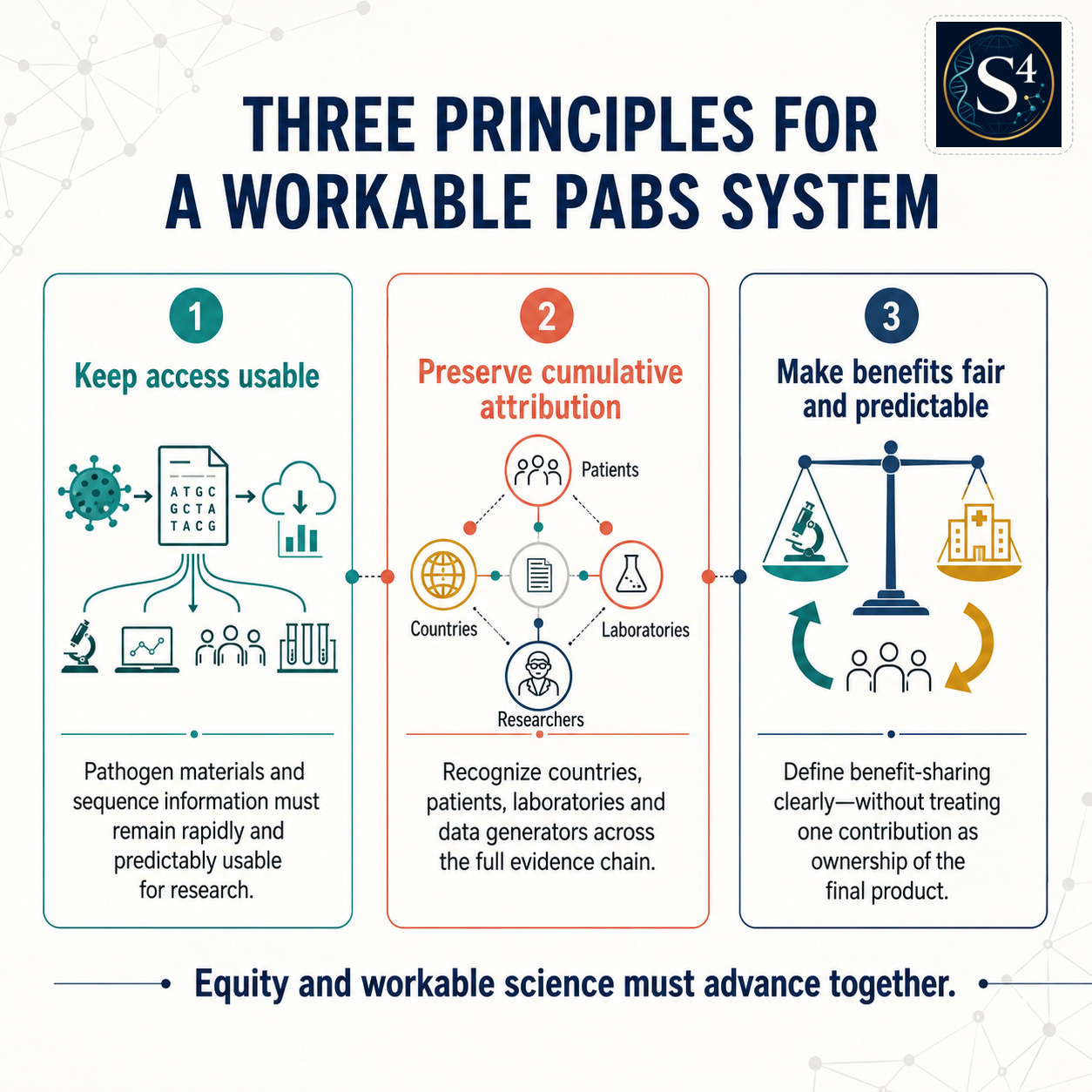
Three design principles for PABS
1. Keep access immediately usable. PABS materials and sequence information should be available rapidly for public-health, academic, and commercial research under clear and predictable terms. Access should not depend on case-by-case negotiations that delay scientifically necessary work during an outbreak.
2. Make attribution cumulative and transparent. The system should preserve provenance, identify specimen providers and data generators, and allow contributors to document their role throughout an outbreak. That supports credit, quality control, and trust without treating one sequence as the sole basis for assigning ownership or downstream benefit claims.
3. Make benefit-sharing predictable and clearly defined. A balanced PABS system should protect rapid, routine sharing while helping ensure that countermeasures are delivered fairly and predictably. The respective roles of governments, manufacturers, funders, regulators, and delivery partners should be established in advance; company commitments should remain contract-based and tailored to capabilities and circumstances. Benefit-sharing should not depend on proving that one jurisdiction’s sample or sequence was the singular foundation of a final product. The lesson from Bundibugyo and M/V Hondius is not that origin, custody, or credit do not matter. They do. The lesson is that countermeasures are built and tested from collective evidence. PABS will work best if it rewards sharing, protects attribution, and supports equitable access without assuming that one patient’s genome can explain—or own—a product designed for the world.
I extend my sincere thanks to Summer Galloway and Natalie LaHood for their insightful discussions and careful review of this article which strengthened the final product.
© 2026 Lawrence D. Kerr. All rights reserved. Excerpts and graphics may be quoted with attribution and a link to the original article. Reproduction in full requires written permission.
Views expressed are solely those of the author and do not necessarily reflect those of his employer or affiliated organization.